
Stop defaulting to the flagship: how teams quietly overpay for LLMs
Most LLM bills are inflated by habit, not by need. A field guide to right-sizing models, with the price math, a worked example, and the cascade pattern that keeps quality safe while the bill drops.
There is a pattern we see in almost every LLM cost review: at some point, someone picked the model at the top of the leaderboard, wired every feature through it, and nobody ever looked again. The bill grows with usage, finance starts asking questions, and the team's honest answer is "that's just what AI costs."
It usually is not. In our experience, most production LLM bills are two to four times higher than the work they are buying, and the gap is not a pricing problem or a provider problem. It is a defaulting problem: the biggest, flashiest model became the default for everything, including the 80% of traffic that stopped needing it a long time ago.
Why everyone defaults to the flagship
The habit is understandable, which is exactly why it survives:
- The benchmark halo. Leaderboards rank models on the hardest tasks anyone could invent: graduate-level math, competition coding, obscure reasoning puzzles. Your ticket tagger is not on the leaderboard. A model that is 20 points better at olympiad problems is often indistinguishable from a mid-tier model at classifying support emails, but the leaderboard number is what everyone remembers at model-selection time.
- Prototype inertia. Prototyping on the best model is the right call: it removes model quality as a variable while you find out whether the product works at all. The mistake is that the prototype's model choice ships to production and is never revisited. The decision was made for week one and billed forever.
- Fear without measurement. Nobody wants to be the person who downgraded the model and broke quality. Without an evaluation set, nobody can prove a smaller model is fine, so the safest-feeling choice wins by default. (This is the same failure mode as iterating on prompts by vibes: no eval set, no opinion.)
- Per-request prices feel free. A cent per request does not trigger anyone's alarm. A cent per request at two million requests a month is $20,000 a month, and it triggers finance's alarm instead.
The price ladder is steeper than the quality ladder
Model pricing in 2026 spans roughly two orders of magnitude between a frontier flagship and a capable small model:
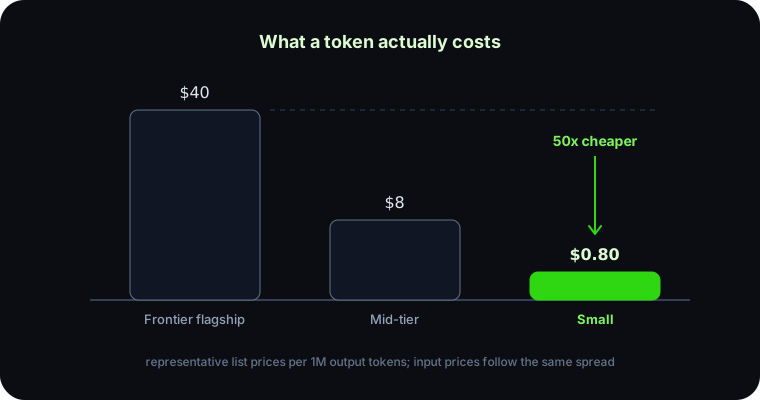
The capability gap between those tiers is real on hard tasks. That is the part people internalize. The part they miss is that on easy tasks, the gap collapses to a rounding error while the price gap stays at 50x. Classification, extraction into a schema, short summaries, reformatting, routing: modern small and mid-tier models handle these at parity or near-parity with flagships, because these tasks were saturated tiers ago.
So the question is never "which model is best?" It is "which is the cheapest model that passes the quality bar for this task?" Those are different questions with different answers per feature.
Your traffic is not a benchmark
Look at what an LLM-powered product actually sends to the model all day. It is not olympiad problems. It is the same handful of narrow transformations, tens of thousands of times:
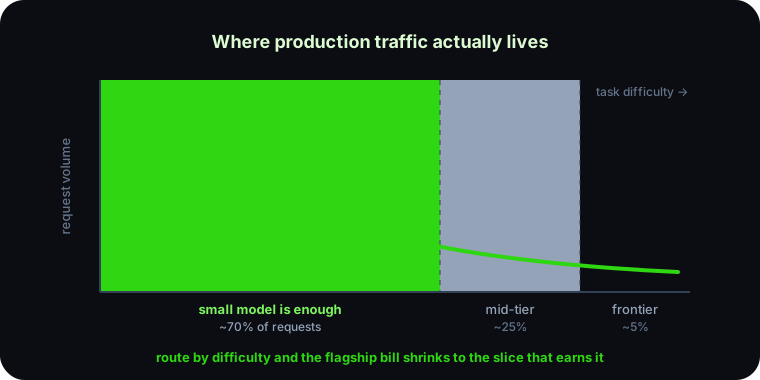
The exact percentages vary by product, but the shape rarely does: volume concentrates at the easy end, and the genuinely hard work (long-horizon agent runs, multi-step reasoning over ambiguous input) is a thin slice at the tail. Sending everything to the flagship means paying frontier prices for the entire area under that curve to cover the sliver on the right.
A worked example
The scenario below is hypothetical: a composite of cost reviews we have done, with the company and numbers invented so we can show the math end to end.
Meet Lumen Desk, a fictional B2B support platform with four LLM features, all launched on a frontier flagship priced at $10 per million input tokens and $40 per million output tokens:
Feature                  Volume/mo   Tokens (in/out)   Flagship $/mo
Ticket tagging           600,000     800 / 30          $5,520
Thread summarization     250,000     2,500 / 200       $8,250
Reply drafting           150,000     3,000 / 350       $6,600
Resolution agent         20,000      30,000 / 2,000    $7,600
Total                                                  ~$27,970
Nearly $28,000 a month, growing with usage. Now run each feature through an evaluation set (200 to 500 real examples per feature with expected outputs) against a mid-tier model ($2 / $8 per million) and a small model ($0.20 / $0.80 per million):
Feature                  New tier    Eval result vs flagship          New $/mo
Ticket tagging           Small       macro-F1 0.93 vs 0.94            $110
Thread summarization     Mid         preferred in 48% of blind pairs  $1,650
Reply drafting           Mid         preferred in 51% of blind pairs  $1,320
Resolution agent         Flagship    kept: completion rate dropped    $7,600
Total                                                                 ~$10,680
A few things worth noticing in those rows:
- Tagging never needed a flagship. A 12-way classifier with clear labels is exactly the kind of task small models saturated long ago. Fifty times cheaper, one point of F1, and that point is recoverable with a few dozen few-shot examples if anyone cares.
- Summarization was the interesting one. The small model was fine on short threads and visibly worse on long multi-participant ones, so it failed the eval. The mid-tier model tied the flagship in blind pairwise preference. That nuance is invisible without an eval set and obvious with one.
- The agent kept the flagship, and earned it. On multi-step resolution runs, the smaller models' task completion rate genuinely dropped. This is the slice of the curve the frontier model is priced for. Paying for it here is not waste; it is the point.
Net effect: the bill drops from ~$28,000 to ~$10,700 a month, about $207,000 a year, and 70% of the remaining spend sits on the one workload that demonstrably needs frontier capability. Nothing about the product got worse. The eval sets are the receipts.
Moving down the ladder without gambling on quality
The reason teams stay on the flagship is that downgrading feels like a leap of faith. The fix is to make it a measurement instead:
- Freeze an eval set per feature. Twenty to fifty real inputs with expected outputs is enough to start; a few hundred is better. This is an afternoon of work per feature and it converts every model decision from opinion to arithmetic.
- Run the ladder. Same eval, every tier, cheapest first. Record pass rates and cost per thousand requests side by side. The result is usually a one-line decision per feature.
- Cascade the borderline cases. When a small model passes 85% of the eval and fails a recognizable 15%, you do not have to choose one model. Route everything to the small model first, check the output (schema validity, confidence, business rules), and escalate only the failures.
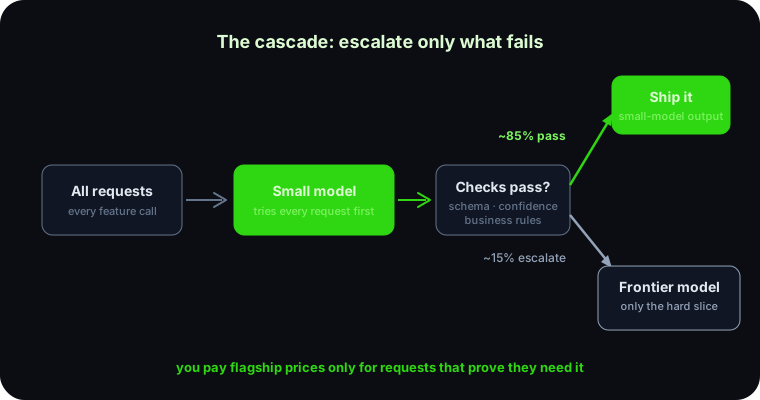
A cascade at 85/15 costs a fraction of flagship-everywhere while quality stays pinned to the checks, not to the model. The failure mode to watch is a lazy escalation gate: if the checks cannot actually catch the small model's mistakes, the cascade quietly ships them. Build the gate from the eval set's observed failure patterns, not from hope.
- Re-run the ladder when models change. Prices fall and small models improve every few months. A workload that needed mid-tier in January is often small-model territory by summer. The eval set makes re-checking a ten-minute job instead of a debate.
The other levers
Right-sizing the model is the biggest lever, but the same review usually finds three more:
- Prompt caching. If every request re-sends the same 4,000-token system prompt and knowledge block, cached-input pricing typically cuts that portion by 75-90%. Structure prompts so the static part is a stable prefix.
- Batch APIs. Anything that is not user-facing-interactive (nightly enrichment, backfills, report generation) usually qualifies for batch pricing at around half off. Latency you were not using anyway is a discount you are not collecting.
- Trim the tokens themselves. Output tokens cost four to five times input tokens, so cap verbosity: ask for the JSON, not the JSON plus a friendly explanation. And context overload is a cost problem as much as a quality one: every "just in case" document pasted into the prompt is billed on every request.
And when a single narrow task runs at high volume even after all of this, that is the profile where fine-tuning a small open model stops being exotic and starts being the obvious next step down the ladder.
When the flagship is the right call
This is not an argument that big models are a scam. It is an argument about defaults. The flagship earns its price when:
- The task is genuinely hard: long-horizon agent work, multi-step reasoning over ambiguous input, novel synthesis. The resolution agent above stayed on the flagship because the evals said it should.
- Volume is low. At a few thousand requests a month, the entire bill is lunch money and the engineering time to right-size costs more than it saves. Optimize the thing that shows up on the invoice.
- You are still prototyping. Model quality should not be the variable while you are finding product fit. Start at the top; just put a date in the calendar to run the ladder before launch.
The failure mode is never "we used a frontier model." It is "we used a frontier model for everything, indefinitely, without measuring."
The checklist
- List every LLM call in the product with its monthly volume and average tokens in and out. Most teams are surprised by this table alone.
- Freeze an eval set per feature. No eval set, no model opinion.
- Run every feature down the price ladder and record pass rate next to cost.
- Cascade the borderline features instead of forcing a single-model choice.
- Cache the static prefix, batch the non-interactive work, cap the output.
- Re-run the ladder on every major model release. The answer changes more often than the decision gets revisited.
The teams with the lowest LLM bills are not the ones with secret cheap models. They are the ones that treat model selection as a per-task engineering decision with a feedback loop, instead of a one-time act of brand loyalty to whatever is on top of the leaderboard this quarter.
Was this useful?
Comments
No comments yet. Be the first to leave one.